Different Perspectives (inc. Mental Crusher)
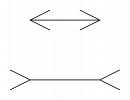
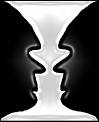
The probably familiar images of two straight lines (of equal length) and a candlestick or wine glass (or two faces) show us that things are often not as they first seem, and there's almost always a different perspective.

When there's a traffic accident, police ask for witnesses to come forward and describe what happened. They like to have as many witness statements as possible so that they can build up enough evidence to give them a broader, more realistic version of events. In a traffic accident, there will be many different perspectives on what happened.
The driver of one car will have one view, another driver or a passenger will have yet another view. Each onlooker who witnessed the accident will have a slightly different perspective, depending on where they were, how far they were, how good a view they had, what else was going on, how much danger they felt they were in, how the accident affected them, what the accident means to them.
It's the same principle with everything - each situation, event, conversation, means something different to all those involved, and also to those not involved. We give different meanings, according to our belief systems, and how we are affected by the event.
We all have our own realities. Anais Nin said:
"We don't see things as they are, we see things as we are"
We look at situations, events, and interpret what other people say and do, according to our own set of past experiences, culture, faith, values, all of which help us form our beliefs about ourselves, about others, and about the world in general. The meaning we give events, the way we make sense of our world, is based upon our set of core beliefs.
Our minds are constantly trying to make sense of our world, forming judgements and opinions about every situation, event, interaction. Those judgements and opinions will be affected by our central or core belief system. It is as though we are looking at the world through distorted or coloured lenses - and everyone has their own personal prescription or colour for their glasses.
Core belief system comprises:
- How I think about myself
- How I think about others
- How I think about the world
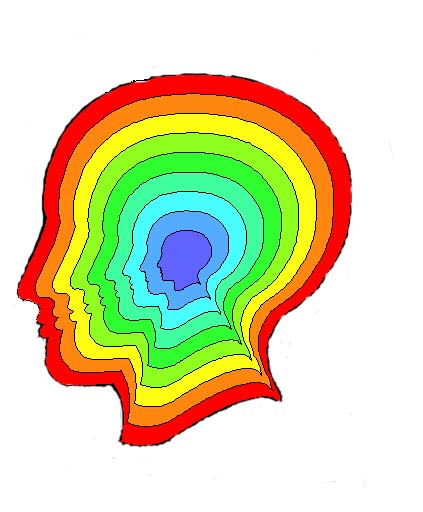
Our core belief system is formed and influenced by:
Past experiences
- Childhood upbringing
- Culture
- Faith
- Values
- Current circumstances
- Character traits, including genetic influences
Example:
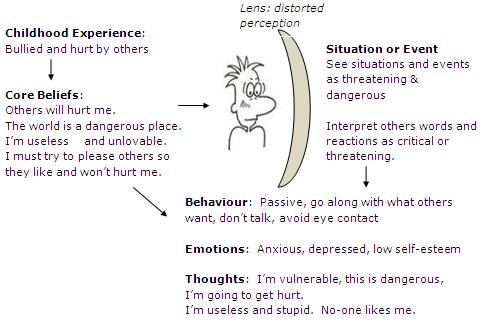
In the example above, even situations in which others present find enjoyable and relaxing, this particular person will experience it very differently, and feel threatened by others.
A look, word or gesture intended to be friendly and kind, may be interpreted as "They don't mean that. They're only trying to be kind to me because they pity me". Or even, "They mean to hurt me". Their mind is interpreting the situation with the bias of "I'm vulnerable, others might hurt me, this is dangerous, I'm useless and unlovable". The mind will work to make any contrary information, fit with those beliefs.
This is shown by "The Mental Crusher" (Butler, Fennel, Hackman 2008)
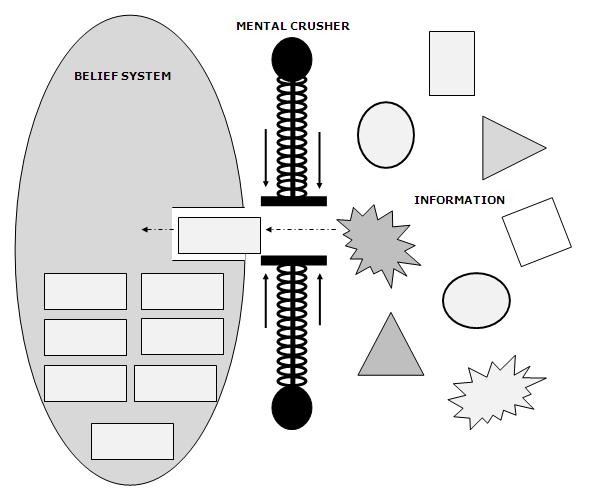
'The Mental Crusher' sits outside the entrance to our belief system, and only allows information or 'evidence' which fits with our own belief system to enter. Any contradictory evidence or information (any shape other than a rectangle) is rejected, or made to fit (crushed into a rectangle). In the diagram, the explosion shape is about to enter the Crusher. As it passes through (shown by the arrow), it becomes a rectangle - it's been crushed and distorted to fit. Therefore, our beliefs remain unchanged in spite of apparently contradictory evidence being out there.
Paraphrased from p. 58 of Cognitive Behavioral Therapy for Anxiety Disorders by Butler, Fennel & Hackman (Guilford 2008).
Print or download "The Mental Crusher" as a PDF document
In the case of our earlier example, the information that 'a person looked at me', is "crushed" and distorted ("they gave me a funny look") to confirm that others dislike or mean to hurt me.
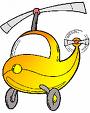 Learning to see things differently: The Helicopter View
Sometimes it's useful to use a metaphor to help us consider the bigger picture. When something is distressing us, we're so close to it, emotionally involved with it, part of it - that makes it really hard to stand back from what's happening. It's like the well-known saying "We can't see the wood for the trees", or like 'Google Earth' - we see the close up view but we can't see anything else.
We can zoom out our view and see the bigger picture. We could call this the Helicopter View. As the helicopter takes off, getting higher and higher, it sees a bigger and bigger picture, and is less involved with the detail at ground level.
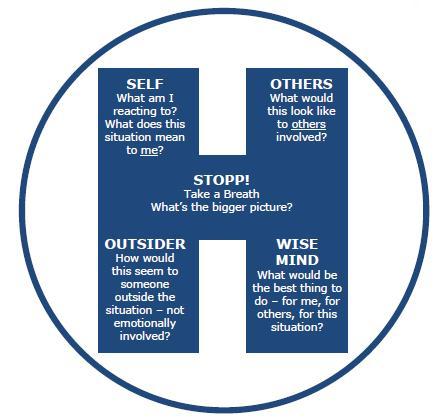
More about The Helicopter View
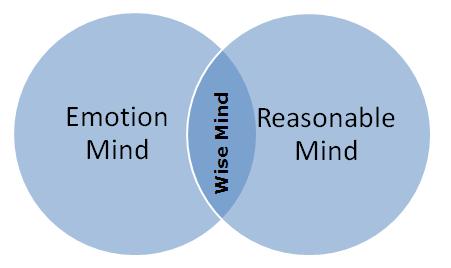
Wise Mind (Linehan 1993) is the balanced part of us that comprises our inner knowledge and intuition, where our emotional thinking mind (thoughts driven by distressing feelings) and rational thinking mind come together, the part of us that just "knows" that true reality.
Emotion mind drives opinion, whilst reasonable mind is fact-based (fact or opinion?) Asking ourselves what 'wise mind' might make of this situation will help us to stand back and be more aware of the bigger picture, and help us respond in more helpful and effective ways.
Within any meeting of people all the individuals will of course have their own belief system, and will therefore have different perspectives - see and think about things differently - and this will affect the way these individuals interact with each other.
We can learn to be more aware of how our own belief system affects us, and consider how others might see the same situation quite differently. Wise Mind is the balanced part of us that comprises our knowledge and intuition, where thinking mind and emotion mind come together, the part of us that just "knows", that inner truth:
Seeing different perspectives will help to reduce distressing emotions, help us feel more confident, enable us to be more understanding and empathic, and improve communication and relationships. Learn to STOPP!
As we learn to challenge our unhelpful thoughts and biased perspectives, and see things in a more balanced and realistic way, so we will discover that situations and people can be different to how we usually interpret things, which can lead us to modify our core belief system, and therefore bring about lasting positive change.
The Guardian: 1986 Points of view advertisement
Useful Links
BOOKS WE LOVE