EMDR
EMDR, or Eye Movement Desensitisation and Reprocessing, is a psychotherapy that has been proven to be effective in treating trauma, and is recommended by the UK's National Institute of Health and Clinical Excellence (NICE) for Post-Traumatic Stress Disorder (PTSD).
Practitioners are also finding it effective in the treatment of other anxiety related disorders. EMDR was developed by American psychologist Francine Shapiro.
EMDR should only be practiced by a qualified mental health professional (with additional accredited training in EMDR), who most usually incorporates the therapy into their usual practice.
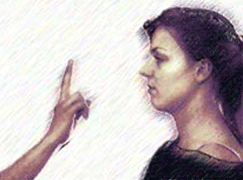
The treatment will consist of several sessions, dependent on the nature of the problem. In the case of a single trauma sustained in adulthood, there will be 1 or 2 assessment sessions, followed by 1 or 2 sessions discussing and preparing for EMDR treatment, using some preliminary exercises (e.g. safe place imagery), and at least 1 or 2 treatment sessions.
The number of actual treatment sessions will again depend on the nature and number of distressing memories or nature of the problem.
EMDR Client Handout
The Processing Factory metaphor
Whilst EMDR is carried out by a qualified EMDR practitioner, the following books give information on self help techniques using the tapping technique (bilateral stimulation) which is used as an alternative to eye movements during EMDR
EMDR Self Help Books
Tapping In - A step by step guide to activating your healing resources through bilateral stimulation
Eye Movement Technique for Emotional Healing (Tapping technique)
Getting Past Your Past: Take control of your life with Self-Help techniques from EMDR therapy

Therapist Resources
BOOKS WE LOVE