Cycling In Cycles: a self help metaphor
Cycling in Cycles: a metaphor for therapy and self help
We talk a lot about cycles in CBT – panic cycles, vicious cycles, maintenance cycles. ‘CBT for Cyclists’ is just a way of looking at a basic CBT self help plan, using cycles and cycling as the metaphor.
“Life is like riding a bicycle. To keep your balance, you must keep moving.” Albert Einstein
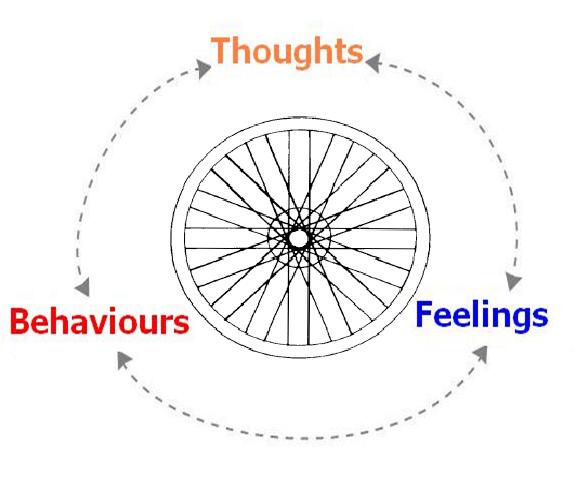
Cycles are cycles. The basic vicious cycle of CBT – thoughts, feelings and behaviours – can be changed or stopped by making changes in one part of the cycle. We can change the way we think, or change what we do – any change we make will impact on the whole cycle.
Right now, there are things you’re probably doing – the way you think, how you respond to those thoughts, and what you do – that are helping to keep this cycle wheel turning.
We can learn to apply the brakes, and change some aspect of the this apparently ever-repeating, perpetually-turning cycle, in order to stop it, or make positive changes to create a more helpful cycle.
Vicious Cycle
What keeps your problem going? What do you often think about, feel and do? Is there anything that you’re doing now that is helping to keep you stuck there? What are the consequences of not making any changes? What helpful changes can you make that will stop this vicious cycle?
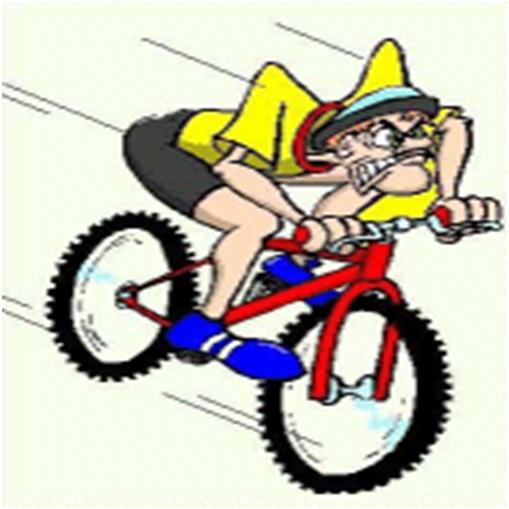
Take a recent typical incident:
Thoughts: What went through your mind at that time? What thoughts or images do I remember having? What did that mean, or what did that say about me? What was I reacting to?
Feelings: What emotion did I have? How intense was it? (0-100%) What did I feel in my body?
Behaviours: What did I do at that time? What was my automatic reaction? What helped me cope? What did I feel like doing?
Doing Differently
What could I have done differently? What would or might have helped more? What would have been the best thing to do?
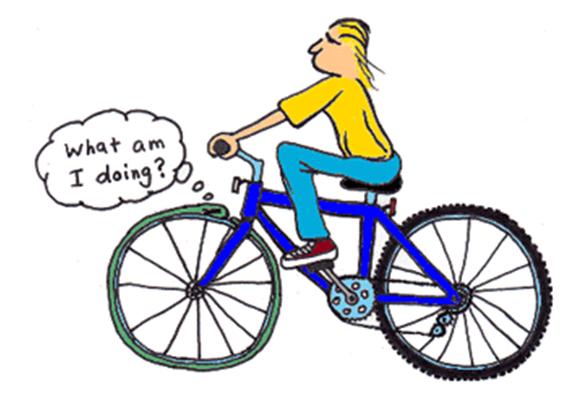
Any physical exercise is great for beating the blues, improving your mood, reduces tension by impacting directly on the physical reactions to anxiety and depression. Cycling is a great all-round activity! Can you do more, change your route, make it greener, more enjoyable, give you more of a sense of achievement?
What can you do less of or stop?
What can you do more of or start?
Thinking Differently
Thoughts are not necessarily accurate or true, and are often unhelpful. Question and challenge those thoughts that lead to you feeling a negative emotion.
- What am I reacting to? What’s pressing my buttons?
- Is that really how things are? Is this fact or opinion?
- What’s the bigger picture or the helicopter view?
- Is there another way of looking at this?
- What would someone else make of it?
- What would a caring friend say to me now?
- What advice would I give a friend in this situation?
- Where is my focus of attention?
Destination: Set your goals:
- Where exactly are you going? What do you want to achieve? What route do you need to take in order to get there?
- How will you know when you get there? How will your life be different? What will you be doing differently at that time? What will others notice about you?
- Can you get there in one go, or do you need to do it in stages – take rest stops? Is it achievable?
- What do you need to take with you that will help?
- How long do you anticipate it will take?
Uphill Cycling
What makes it tough going? What holds you back? What are you carrying on that rack, or in your rucksack? What will help you at those times?
Pedal harder?
- What will help you do that? Focus on the road ahead – the brow of the hill? When those unhelpful thoughts come to mind (you can’t do this, It’s too much, You might as well give up now, You’re useless, etc.), you can just notice them, then bring your focus back to the road ahead, on keeping up a regular cadence (turn of the pedals).
 Change gear?
- What will help or remind you to change gear? What would that look like?
Take a rest?
- What will remind you? What else do you need to do whilst you’re resting in order to help you continue? What nourishment do you need?
Do something different
- Change direction? Take a side road, turn around?
What else could you differently that might help?
Mindful Cycling
When riding on roads, you’ll need to keep your focus of attention on the road ahead, staying alert for possible dangers. However, it’s easy to drift into ‘automatic pilot’ at these times. Where’s your focus of attention?
Our minds drift off into our own inner focus. Whenever you notice your mind drifting into current concerns, regrets of the past, or future worries, just bring your attention back to here and now – to the road ahead, what’s happening around you, the sensations of cycling, the pedalling, sensation of speed, wind on your skin etc.
Applying the brakes
What will help you apply the brakes when you’re starting to feel out of control? Perhaps angry or very anxious.
Keep calm and carry (pedal) on.

STOPP and Step Back (from the situation, in your mind)
- Don’t act immediately or automatically. Pause.
Take a Breath
- Notice your breath as you breathe in and out.
Observe
- What am I thinking about?
- What am I focusing on?
- What am I reacting to?
- What am I feeling in my body?
Pull Back – Put in some Perspective
- Zoom out! See the bigger picture (the helicopter view)
- Is this how it REALLY is?
- What would someone else say about this?
- How does this affect others?
- How important is this situation right now?
Practise what works
- What’s the BEST thing to do?
- Consider the consequences.
- Do what will help most!
Tandems & Trailer-bikes
Whose tandem would you like to ride on? Whose example would you like to be following? Who could you model yourself on? It can be a real or imagined person, or a screen character. Model yourself on that person – act as though you are that person, or imagine yourself in situations you dread, acting as though you are that person.
Panniers
What resources do you need to be carrying with you? What resources do you have available to you? We tend to focus only on our weaknesses, but we all have enormous reserves of resources, often only used at certain times, for example in one situation such as work, or at times of family crises. But if you have those strengths and resources at those times, then you have them available to you at any time – you just need to remind yourself that those resources are there in order to access them.
Cycle Touring
Cycle tours are just enjoying the ride. Cycling for the pleasure of cycling. It’s not just the arriving, but it’s the ‘getting there’. Whilst it can still be hard work, it feels more ‘effortless’, a sense of enjoyment, just cruising along.
- What are we doing differently at those times?
- How are we thinking differently on those days?
- Can we learn anything from those touring days? Can we do or think in a similar way, on days when it’s more of a struggle? If we’re faced with a tough uphill ride on a windy day, if we think and do the way we do on a touring day – how will we be thinking differently? What will we do differently?
Crashes & Punctures
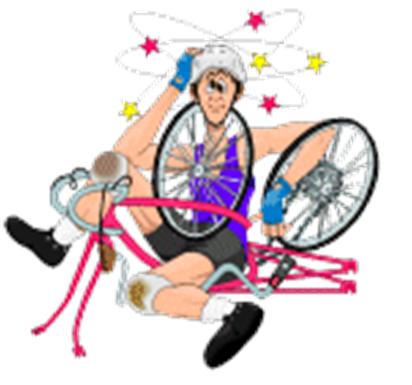
We all fall off the bike sometimes, or get punctures. It happens. It’s okay. We can just pick ourselves up, check ourselves and the bike, do any repairs, and carry on.
Maintenance Cycle
Usually in CBT, we think of the maintenance cycle as what is keeping (maintaining) the problem – like the vicious cycle. We can look at maintaining progress.
- What do you need to keep doing that helps? What can you do more of or start? What can you do less of or stop?
- How can you keep yourself thinking differently? What will remind you to keep practising?
Cycling in Cycles: CBT Metaphor This page as PDF
Browse Cycles And Gear

BOOKS WE LOVE