Chronic Pain and Fatigue Self Help
IMPORTANT NOTICE - new guideline for ME/CFS
The UK's National Institute for Health and Care Excellence (NICE) has released new guidelines for ME & Chronic Fatigue
BBC News article - general information
Science Media Centre - expert reaction
The updated guidance for England and Wales recommends people judge their own "energy limit" when undertaking activity of any kind, and a physical activity programme should only be considered in specific circumstances.
The article below and the linked printable PDF has not yet been updated
______________________________________________________________________________________________
Self help guide for chronic pain and/or fatigue, using effective CBT strategies. Make sense of the problem, then learn how to make positive changes
Save or print this page as a PDF
Because of the chronic and persistent pain and fatigue, it is easy to get into habits of activity and rest that may not be the best way to deal with the pain and fatigue. CBT can help to identify those unhelpful ways of thinking and acting, and help us make healthy and positive changes, and therefore reduce the pain and fatigue.
Okay, I have this medical condition. What’s keeping the pain and fatigue going now?
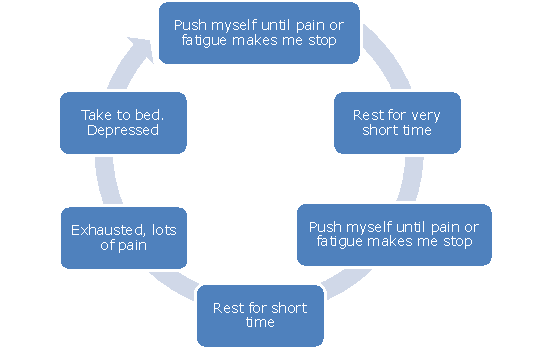
Breaking this simplistic vicious cycle means stopping before the pain or (physical and mental) fatigue makes you stop - and scheduling in some rest periods. Thoughts and physiological factors also play a significant part in the cycle:
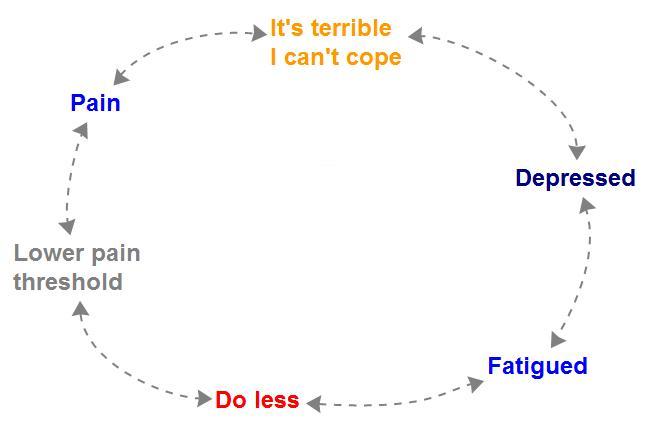
There are several factors which contribute to fatigue and pain, on top of an existing chronic pain or chronic fatigue condition. These include:
Doing too much too soon after illness.
Resting too much for too long.
- The longer you rest, the more symptoms you will have later
- Prolonged rest makes it harder to get active again and increases fatigue
- Prolonged rest affects the heart and lungs, nervous system, and muscles.
Boom and bust
- Doing too much when you have some energy, results in feeling more tired and experiencing more pain, and then have to rest for longer
Disturbed sleep
Thinking about Pain and Fatigue
- Worrying and focusing on fatigue and pain tends to make them more prominent in our attention, resulting in experiencing more pain and fatigue
- Worrying that the symptoms may be a sign of getting worse, or after an activity, we might worry that we’re harming ourselves by what we’re doing
- Financial difficulties – due to not being able to work, or having to work less
- Worry about being able to do what needs to be done
- Feelings of guilt in not doing what we think we should be doing, thinking that we’re letting others down
Mental fatigue
- Difficulty concentrating, easily distracted, poor understanding
- Poor short term memory, difficulty retaining new information
- Forgetting how to do things that used to be done automatically, without thinking
These can all lead to feeling low in mood, frustration, anxiety, helplessness, sense of loss of control, and depression. This causes us to feel even more tired and experience more pain.
A more complicated vicious cycle of pain and fatigue might therefore look like this:
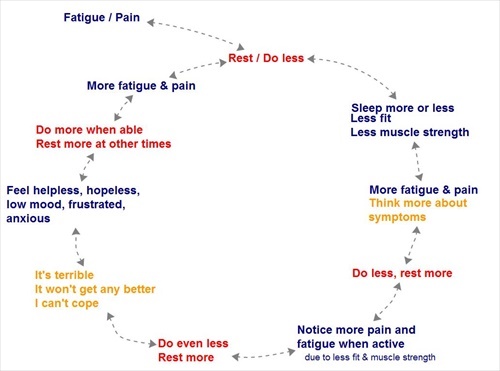
All these factors interact with each other, so we could have several double-ended arrows crossing the circle.
As with other vicious cycles, we can learn to break them by doing something differently (at the points in red) or thinking differently (at the points in orange).
Helpful techniques include:
- Doing things differently
- Monitoring and pacing activity
- Scheduling in rest and relaxation, fun and enjoyment, achievement
- Rewarding yourself
- Physical exercise
- Problem solving
- Goal setting
- Thinking differently
- Thought challenging
- Defusing techniques
- Focus of attention
Learning these techniques will not cure your pain, fatigue or the underlying medical condition, but making these changes can help you take control of your life, enabling you to live a more enjoyable, independent and fulfilling life.
DOING THINGS DIFFERENTLY
Monitoring and pacing activity
-
Complete the Activity & Rest Diary PDF for a week or two, then look through it and notice the times when the pain or fatigue is not so bad, or feels particularly bad. Are there any patterns? Are there activities or doing activities for certain periods of time that influence your pain or fatigue? Are there activities which seem to result in feeling less pain or fatigue? Notice the times when pacing yourself might have helped.
-
Pace yourself. Plan to do the activity for periods of time that are okay, and mean stopping the activity before your body makes you stop (pain and fatigue). Schedule in rest periods.
-
Use the Activity & Rest Diary PDF again, to schedule in more of the activities which seem to help, and less of the activities which are more unhelpful.
-
Be aware of times when doing less, or doing an activity for less time, or resting would have been helpful - and ensure you remember to allow for this when planning your days.
Scheduling in rest and relaxation, fun and enjoyment, achievement
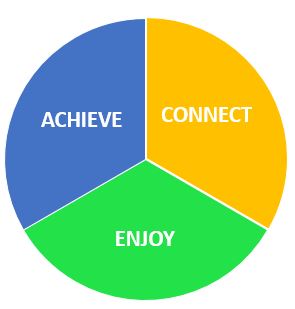
- Use ACE
- It's important to get a healthy balance of activities which give you a sense of achievement, enjoyment and being close to others. Choose activities which are important to you, have positive meanings, or are purposeful. Ensure you schedule in rest periods too.
Rewarding yourself
- When you're doing well, or remembering to pace yourself, doing more of what helps, or doing less of what doesn't - give yourself a treat, a pat on the back.
Physical exercise
- Check out with your GP or other appropriate health professional how you can gradually increase physical exercise. Devise a plan with them - and stick to it.
Problem solving
- Use the Problem Solving guide when faced with a big or difficult problem
Goal setting
-
Set yourself some short-term goals to help guide you in your new regime
-
Start with small steps - break down your goals into smaller, simpler, easier steps
-
Follow this guide:
-
Decide what you want to achieve - be specific!
-
Make sure the goal is realistic and achievable. Set a time frame that you want to achieve this by - again, realistic and achievable. Do you have the necessary resources?
-
Clarify your goal - what is it you really want to achieve? What for? Is this something you need, or just want? How important is it? What difference will it make to you?
-
Write down you goal - add as much detail as you can about what you want to achieve. Write down the steps you need to achieve on the way to the ultimate goal. What do you need to do? When? How? What help do you need? How will you know when you've got there? What will you be doing differently? What will other people notice about you?
-
Do it! Start with the first step - don't try to leap ahead, just take things steadily and achieve one step at a time.
-
Review your goals every day, asking yourself what you've done to work towards your goal? What do you need or what are you able to do today? Stick with it, keep at it. You will much more likely to achieve your goal if you are determined and persistent.
-
Congratulate and reward yourself when you achieve the steps on the way, and when you achieve your goal.
Other suggestions
-
Practise Mindfulness
-
Focus your attention fully on another activity - Mindful Activity
-
Relaxation techniques - try lots and find one that works for you
-
Put on some music - sing and dance along, or just listen attentively (use music that is likely to help you feel your desired emotion - avoid sad songs if you're depressed)
-
Meditation or Prayer
-
Help others
-
Be with others - contact a friend, visit family
-
Talk to someone
-
Grounding Techniques - look around you, what do you see, hear, smell, sense? Hold a comforting object.
-
Engage in a hobby or other interest. If you don't have one, find one. What have you enjoyed in the past? What have you sometimes thought about doing but not got around to?
-
Write down your thoughts and feelings - get them out of your head
-
Just take one step at a time - don't plan too far ahead
-
Pamper yourself - do something you really enjoy, or do something relaxing
-
Positive Self-talk - encourage yourself, tell yourself: I can do this, I am strong and capable - find a positive coping statement or affirmation that works for you (even if you don't believe it at first!). Write it down and memorise it for when you need it.
-
Do something creative - make a box of items that remind you to use the techniques that help, or put photos on paper, or write and decorate a list
-
Use Safe Place and relaxing Imagery
-
Tell yourself: "I've got through this before, I can do it now". When we're going through a tunnel and become fearful of being trapped, there's no point in stopping - we just have to carry on in order to reach the end of the tunnel. That light is there, and waiting!
-
Avoid alcohol, drugs (other than those prescribed by your doctor) and cigarettes.
-
Eat a healthy diet
-
Drink 6-8 glasses of water each day
-
Find ways of helping you get more sleep at night
-
Consider a TENS machine
- Take professional advice for starting an exercise regime - See NHS videos here
- Nature as Therapy
THINKING DIFFERENTLY

-
STOPP! Pause, take a breath
- Ask yourself:
-
What's going through my mind now? What meaning am I giving this?
-
What am I reacting to? What have I been thinking about here?
-
Thoughts are just thoughts
-
Is this the mind bully?
-
What meaning am I giving this?
-
How am I making sense of it all?
-
Am I getting things out of proportion?
-
Am I thinking negatively about the future? Am I comparing my current situation to how things used to be?
-
Can I think more flexibly?
-
Am I expecting something from this person or situation that is unrealistic?
-
What's the worst (and best) that could happen? What's most likely to happen?
-
Am I using that negative filter? Those gloomy specs? Is there another way of looking at it?
-
How important is this really?
-
What advice would I give to someone else in this situation?
-
Am I spending time ruminating about the past or worrying about the future? What could I do right now that would help me feel better?
-
Am I putting more pressure on myself, setting up expectations of myself that are almost impossible? What would be more realistic?
-
What do I want or need from this?
-
Am I just focusing on the worst possible thing that could happen? What would be more realistic?
-
Is there another way of looking at this?
-
Am I exaggerating the good aspects of others, and putting myself down? Or am I exaggerating the negative and minimising the positives? How would someone else see it? What’s the bigger picture?
- Things aren’t either totally white or totally black – there are shades of grey. Where is this on the spectrum?
-
This is just a reminder of the past. That was then, and this is now. Even though this memory makes me feel upset, it’s not actually happening again right now.
-
What would be the consequences of doing what I normally do?
-
Is there another way of dealing with this? What would be the most helpful and effective action to take? (for me, for the situation, for the other person)
Save or print this page as a PDF
Learn effective skills online - The Decider Skills for Self Help online course.
 HEALING COLOURED LIGHT visualisation mp3Female voice, with music. 13 mins 40
 2.50
2.50 
Using colour imagery to target particular psychological or physical problems such as anxiety, stress, insomnia, depression, chronic pain, infections and tumours.
HEALING COLOURED LIGHT visualisation mp3
Male voice, with music.
15 mins2.50
Using colour imagery to target particular physical or psychological problems such as chronic pain, infections and tumours, anxiety, stress, insomnia and depression.


NHS Exercise Videos including for e.g. fibromyalgia etc
Self Help Books

Beating Chronic Fatigue: Your step-by-step guide to complete recovery

Fatigue and Fibromyalgia Solution: The Essential Guide to Overcoming Chronic Fatigue and Fibromyalgia, Made Easy!

Overcoming Chronic Pain: A Self-Help Guide Using Cognitive Behavioral Techniques


Pain Management: Ultimate Pain Relief Guide- Discover The Best Strategies For Dealing With & Overcoming Pain
BOOKS WE LOVE